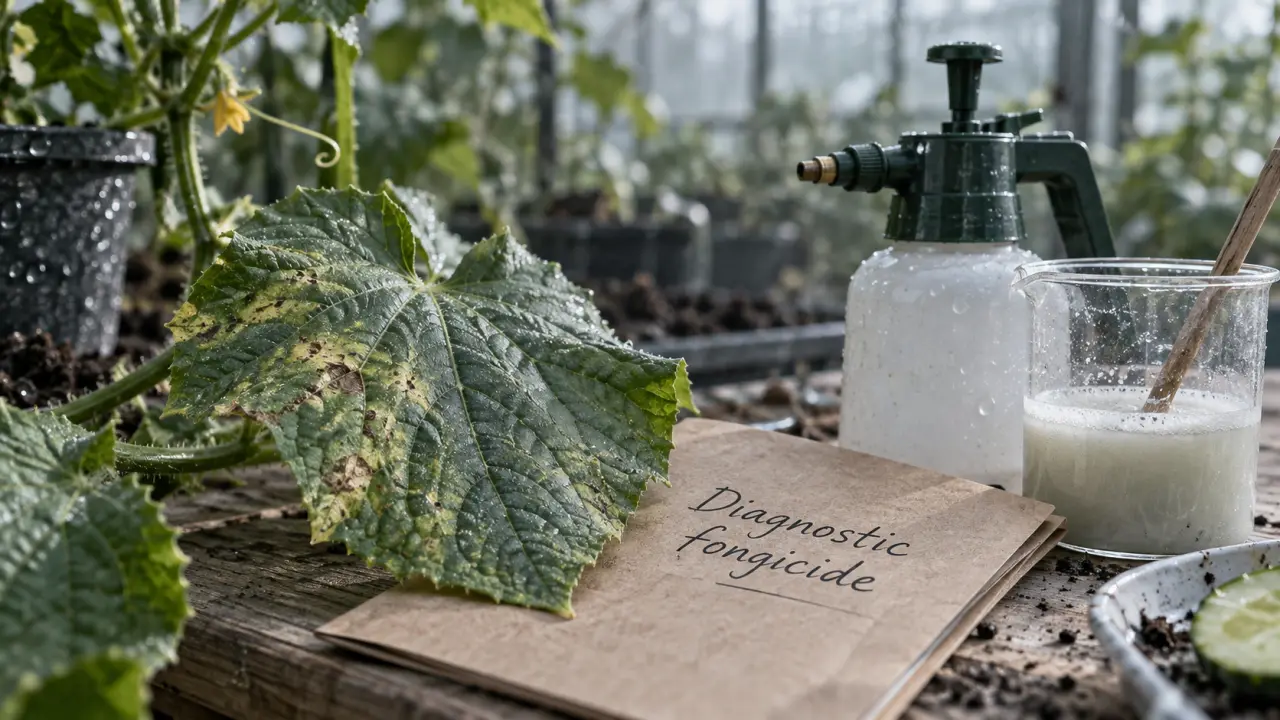
An organic vegetable fungicide can help manage powdery mildew, leaf spots, blight, damping-off and some root diseases. It will not correct every yellow leaf or wilted plant. Identify the symptom first, then match the treatment to the crop, disease and application site. The product label remains the final authority for edible-crop use, mixing, timing and harvest restrictions.
Identify the problem before choosing a treatment
Fungal diseases often follow recognizable patterns. Powdery mildew appears as pale, floury patches on leaves. Downy mildew usually starts as angular yellow areas, sometimes with gray or purple growth underneath. Leaf spots are more defined, while blight can produce brown or black lesions that expand quickly. Root rot and damping-off affect the stem base or roots and may cause plants to collapse, especially in wet growing media.
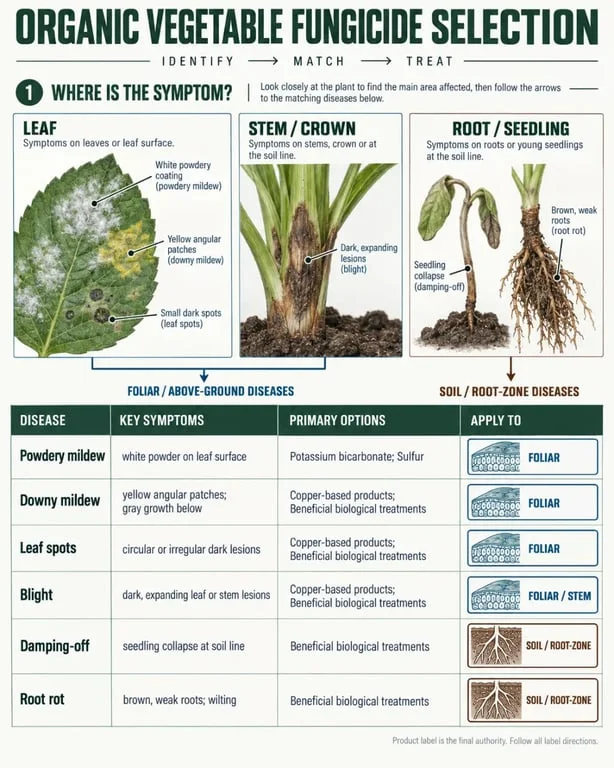
Similar symptoms can have other causes. A nutrient deficiency may create even yellowing without any fuzzy growth. Heat, underwatering, herbicide drift and poor drainage can scorch, curl or wilt leaves. Bacterial diseases may produce wet-looking spots, halos or oozing lesions. Viral diseases can cause mosaic patterns and distorted growth. Fungicides do not treat viral diseases.
Use your phone as a diagnostic screen, not a diagnosis
A close photograph on a screen can make a leaf spot look more severe than it is while hiding clues such as growth on the underside, stem lesions or soggy soil. Inspect the whole plant in daylight. Check older and newer leaves, turn the leaves over, examine the crown and compare several plants. Note whether symptoms appeared after humid weather, heavy rain, a cold spell or a change in watering. This inspection can prevent repeated spraying when the real problem is a waterlogged root zone.
Match the active ingredient to the disease pressure
“Organic” does not mean that every product works in the same way. Some ingredients act mainly as protectants on leaf surfaces. Biological products are used to support disease suppression around leaves and roots. Select an active ingredient only when the label lists both your vegetable and the disease or use situation.
| Active ingredient type | Typical use situation | Key point to check |
|---|---|---|
| Potassium bicarbonate | Powdery mildew on foliage | Coverage, repeat interval and crop sensitivity |
| Sulfur | Powdery mildew and some fungal diseases | Temperature limits and label restrictions |
| Copper-based products | Some leaf spots, blights and bacterial disease situations | Crop approval and frequency limits |
| Neem or other plant-based oils | Surface disease management where labeled | Timing, heat and plant-safety directions |
| Beneficial bacteria | Preventive foliar or root-zone disease suppression | Permitted crops and application method |
| Streptomyces lydicus | Damping-off and root rot management where labeled | Soil, transplant or potting-mix directions |
For example, formulations containing Bacillus amyloliquefaciens strain F727 may contain 96.4% cells and spent fermentation media, with a minimum of 1 x 10⁹ cfu/mL. Their usefulness depends on applying them exactly as directed. Biological treatments are generally positioned for suppression and prevention, not as a guaranteed rescue for plants that are already heavily diseased.
Choose a format that suits your garden and crop
Ready-to-use sprays are convenient for a few container plants or for treating early symptoms because they require no measuring. Concentrates usually cost less per treatment for larger beds, but an incorrect mix can damage plants or reduce results. Hose-end sprayers are practical for broad coverage, although they offer less precision in small vegetable plots.
Read dilution and harvest directions literally
Application rates vary widely between products. One concentrate may call for 0.25 oz mixed with 32 oz of water, while another uses 1 oz per gallon. A separate concentrate may require 2 oz per gallon. Never transfer a rate from one brand to another.
Some products are labeled for use on edible crops up to the day of harvest, but that permission applies only when the exact label states it. Wash produce as appropriate and respect any pre-harvest interval shown. The label also determines whether the product can be applied to leaves, soil, transplants, potting mixes, rooting compounds or hydroponic crops.
Look beyond front-label wording such as “natural” or “plant-based.” If organic production matters to you, verify whether the exact formulation is OMRI listed or accepted by your organic certifying agency. The active ingredient, inert ingredients, registration and permitted uses can differ by formulation and location.
Apply an organic vegetable fungicide with fewer setbacks
Apply treatment early, before disease covers large areas. Remove severely affected leaves when practical and clean pruning tools. Spray both leaf surfaces only when the label directs it. Soil-applied biological products require different instructions, so follow the directions for watering cycles, transplants, potting mixes or hydroponics instead of treating them like a foliar spray.
- Mix only the amount needed, using clean water and equipment.
- Spray in calm conditions to limit drift onto nearby plants, people and pollinators.
- Avoid treating drought-stressed plants. Do not spray oils or sulfur in unsuitable heat.
- Wear the protective equipment required on the label, even with an organic-approved input.
- Repeat only at the stated interval. Some products distinguish 10–14 day applications for plant wellness from 5–7 day schedules for major disease control.
- After rainfall, reassess the plant and follow label guidance on reapplication.
Reduce the need for sprays in the first place
Fungicides work best as part of a broader disease-management plan. Give tomatoes, cucurbits, peppers and other dense crops enough space for airflow. Stake or cage plants so foliage dries faster. Water the soil rather than the leaves, preferably early in the day. When disease is active, remove infected debris instead of adding it to the compost.
Choose disease-resistant cultivars when available and rotate crop families between seasons. Avoid excessive nitrogen fertilizer, which can produce soft, crowded growth. These practices lower humidity around foliage and reduce the spores or pathogens available to spread. If symptoms continue despite good care and label-correct treatment, remove badly infected plants to protect the rest of the vegetable garden.
{“@type”:”Article”,”@context”:”https://schema.org”,”headline”:”Organic Vegetable Fungicide: Match the Disease Before You Spray”,”inLanguage”:”en-US”,”description”:”An organic vegetable fungicide can help manage powdery mildew, leaf spots, blight, damping-off and some root diseases. It will not correct every yellow leaf or wilted plant….”}
Observe the plant before changing the routine
Rose and garden advice depends on climate, soil drainage, sunlight, airflow and the age of the plant. Before pruning, feeding or spraying, look at the leaves, stems, buds and surrounding soil. A rose in a windy dry spot needs different care from one growing in humid shade, even when the symptoms look similar at first glance.
Avoid applying several treatments at once. Water correctly, remove damaged growth, improve airflow and identify pests or disease before reaching for a spray. A measured response protects beneficial insects and helps the plant recover without unnecessary stress.
Related guides to continue
To build a stronger understanding of this topic, continue with these related guides from the same site. They cover nearby decisions, maintenance points and practical details that often influence the final result.